
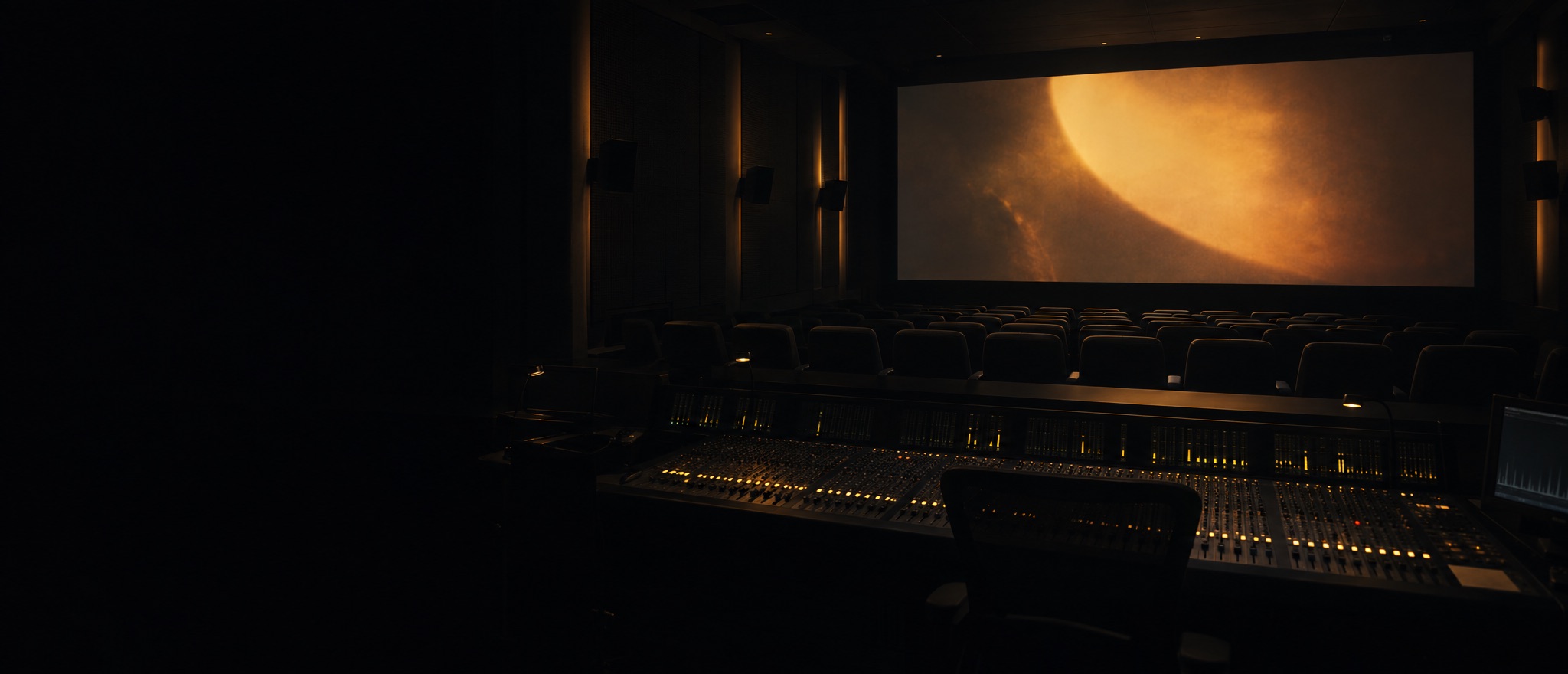
Audio as a production graph, not an afterthought.
Dialogue, voice identity, dubbing, ambience, Foley and score are first-class production data linked to the script and the cut — not a final pass bolted on after picture lock.
What you get
The capabilities that matter most to this role.
Lines, takes, emotion, pace and pronunciation tied to the screenplay, with ADR-style replacement.
Per-character voice profiles with multilingual mapping and consent metadata recorded against them.
Translation with timing constraints and mouth-aware rewriting, producing alternate-language masters.
Prompted effects and library assets with sync markers and scene-level ambience beds.
Cue briefs with duration and intensity curves, delivered as revisable stems.
Dialogue, music and effects buses with loudness targets, limiting and stem export.
Your workflow
Where you sit in the production graph, start to finish.
- 1Cast the voices
Assign voice identity per character with consent recorded.
- 2Generate dialogue
Script-linked lines with performance direction and lip-sync where needed.
- 3Build the beds
Scene ambience, Foley and effects with sync markers.
- 4Brief the score
Cue duration and intensity curves per sequence.
- 5Mix
Buses, loudness normalisation and limiting to delivery targets.
- 6Localise
Dubbed masters and subtitle timing per territory.

Audio starts at the script, not at picture lock.
Dialogue lines, voice identity, ambience, Foley and cue briefs are production data linked to the screenplay and to the cut.
What this solves
The failure modes generative production runs into, and how the platform answers them.
| The problem | How VFX.plus handles it |
|---|---|
| Audio starts after picture lock | Dialogue and cues are linked to the script from breakdown onward. |
| Voices drift between scenes | Per-character voice identity with consent metadata. |
| Dubbing breaks timing | Mouth-aware rewriting under explicit timing constraints. |
| Stems assembled by hand | Buses, loudness targets and stem export are part of delivery. |
Built for every other role too





Ready to bring your team into the loop?
Request early access and we'll walk through your production.